
The Caregiver-as-Coach Model: How Parents Can Support Their Teen's Social Skills
If you’re a parent or caregiver recognizing noticing that your autistic teen has worked hard on social skills in therapy and made real progress in the clinic, but they continue to have difficulty applying these skills in everyday life, you’re certainly not alone. Structured clinic sessions and the unpredictability of everyday life often feel like two different worlds.
This gap is well documented, and it's often not due to a lack of skill but rather a reflection of the difficult of generalizing knowledge or transferring knowledge into practice. Skills practiced in structured settings don't automatically move to unstructured ones.
The research points to a clear solution: parent and caregiver involvement. When the adults in a teen's life understand the skills they're working on and can support practice at home, skill transfer improves significantly. This is the foundation of the caregiver-as-coach model.
What a Social Skills Coach Actually Does
Being a social coach for your teen doesn't mean hovering, correcting, or narrating their social choices. It means:
Understanding the specific skills your teen is building — in concrete, observable terms
Recognizing when those skills come up naturally in everyday life
Offering low-stakes opportunities to practice without making it feel like a test
Debriefing after social situations in a way that feels curious and supportive rather than evaluative
Knowing when to step in with a gentle, pre-agreed cue and when to stay back
The best social coaches are warm, attuned, and unhurried. They understand that skill development isn't linear and that a hard day isn't a setback — it's data.
The Importance of a Shared Vocabulary
One of the most practical things you can do is build a shared language with your teen around social communication skills. This doesn't have to be clinical. It might look like:
Having a name for the steps of starting a conversation, so you can reference them naturally
A private signal — a word, a gesture, a text — that means "I think this is a moment to use that skill"
A lpost-event debrief habit: "What went well in that interaction?” “What was the hardest part?"
When teens and caregivers have a shared vocabulary, they can communicate about social experiences without it feeling like a report card. It becomes a conversation between two people working toward the same goal.
Creating Opportunities Without Creating Pressure
One of the challenges of home-based coaching is that everyday social moments move fast. A family dinner, a trip to the grocery store, a text exchange with a classmate — these aren't controlled practice environments. They're real life.
The key is to create low-stakes practice opportunities where the goal is to try, not to succeed. This might look like:
Casual conversations at home where a teen can practice a new opener or a wrap-up skill
Role-playing a scenario together before it happens (asking a friend to hang out, navigating a group chat)
Watching and discussing social interactions observed in TV shows or media — not as judgment but as observation
These moments work best when they're light, optional, and driven by your teen's own goals — not by a checklist.
When You're Not Sure What to Coach
The caregiver-as-coach model works best when parents have a clear framework to work from. Knowing what to focus on, in what order, and how to talk about it at home is a skill in itself — one that most parents don't learn automatically.
That's exactly the gap a structured coaching program is designed to fill: giving parents the tools, language, and frameworks they need to support their teenager's social communication at home, with confidence.
Support for Families of Autistic Teens — At The Speech Path and Beyond
At The Speech Path, we offer individualized speech therapy and social communication support for autistic teens in San Francisco, as well as virtual services for families throughout California. We also offer PEERS® for Adolescents — a research-backed group program for building real-world social skills.
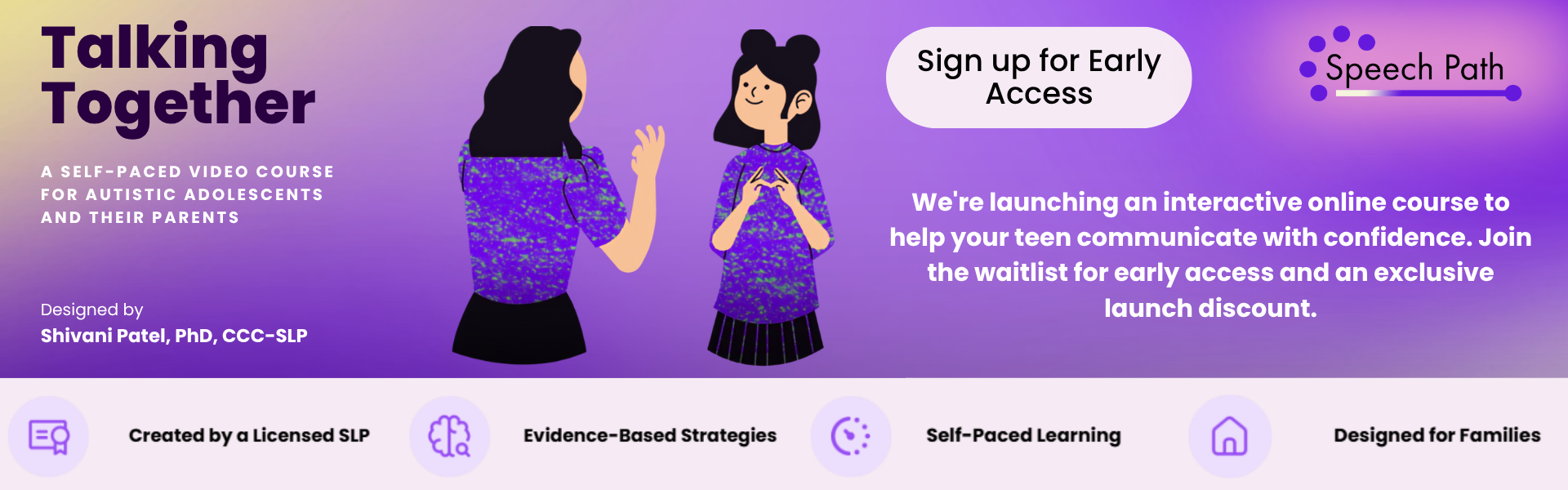
We're also building something new: a self-paced e-course, Talking Together: A Conversational Skills Program for Autistic Adolescents and their Parents. This program is launching later this summer, and you can join the waitlist today! It’s designed for caregivers who want to support their teen's conversation and friendship skills at home. The program will give you, the parent, and your teen the support to enhance conversational skills in the real world. Stay tuned — we'll share more soon.